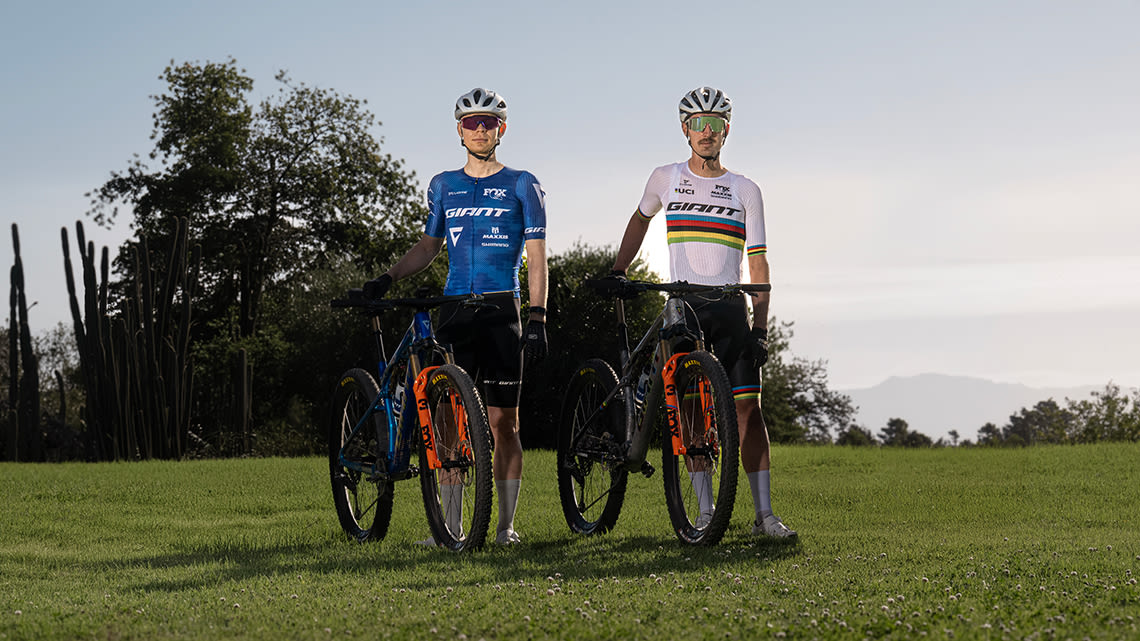
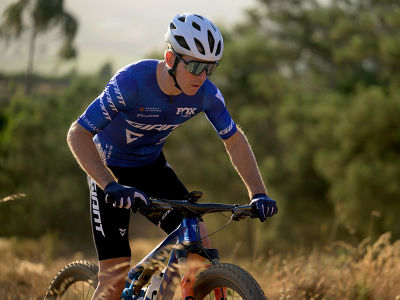
Do you default to high or low geometry—and what exact course features trigger the other setting?
AH: I use the low position the most. When I received the first prototype test mule in early 2025, we spent time evaluating both the high and low positions, and both options have great sensations on the trail. The low position ultimately suits my bike fit and body position better and is easier for me as I switch between road and mountain bike racing during the season.
DL: My default is the low position. I switch to high for slower, more technical tracks where you need more ground clearance from pedal strikes and tighter, faster steering response.
Tell us about a race where you changed one setup detail and it immediately paid off—what happened on course?
AH: At the 2025 XCO World Championships I decided to race the new Giant XCR wheels. We had been testing multiple prototypes up to that point in the season and were still switching between XCR and our hand-built wheels from race-to-race, so it was a big decision. After practice at worlds, I was confident that the XCR was the fastest wheel, and the Wide Guard rim saved me several times when I was out front burying myself.
DL: At the first World Cup in 2026 in Mona PyonYong the weather conditions changed quite dramatically overnight before the race. We changed the tires to the Maxxis Beaver, which is a narrow mud tire. We started the race with an aggressive tire pressure, 1.25 bar in the front and 1.3 bar in the back, which is very low for the width of the tire. In addition we slowed the rebound on the suspension to make the bike more stable on the wet downhills. We also added grip tape to the controls so they weren’t slippery, added toe spikes to my shoes for running, and removed my chain guide for better mud clearance in the drivetrain. These changes paid off in the end and I was able to win my first Elite XCO World Cup on that setup.
Walk us through a Thursday practice to Sunday race evolution—what usually gets changed, and why?
AH: Thursday is when we see the track for the first time and it’s a busy day. I start with a recon lap with my teammates and our technical coach, who has already done several laps beforehand to help guide us through and show us line options. Following practice days naturally become faster due to lap traffic riding in the lines, and my mechanic is always positioned in the feed zone with tools and wheelsets, with different tire options, to help fine tune my setup for higher speeds. The last thing I do are my hot laps to confirm that everything is ready for racing.
DL: My mechanic and I make initial suspension setup and tire choices based on previous experiences on the same or similar tracks, then fine-tune day-to-day based on weather and track conditions.
How do you decide gearing range? What data or insights do you look to—course, power files, cadence preference, or race strategy? Conversely, is it just by feel?
AH: I like the tighter ratios on the XTR 9-45T cassette versus the 10-51T option, and I generally don’t change that. I decide on chainring size after seeing the course and thinking about how the race will unfold. If the course will result in a lot of bottlenecking and hard accelerations, I will go for a smaller chainring just to be on the safer side. A 36T or even 34T chaining can make a big difference throughout the race, and with the 9T it's still a big enough gear to turn should it come down to a sprint finish.
DL: I ask myself “How long and steep are the climbs? How likely will I need a big gear for a sprint? How long are the sections where I will be pedaling the most? What are the transitions from climbs to descents like?” Ideally you want to spend as little time as possible shifting between the highest and lowest gears, so I choose chainring size accordingly to find the right balance.